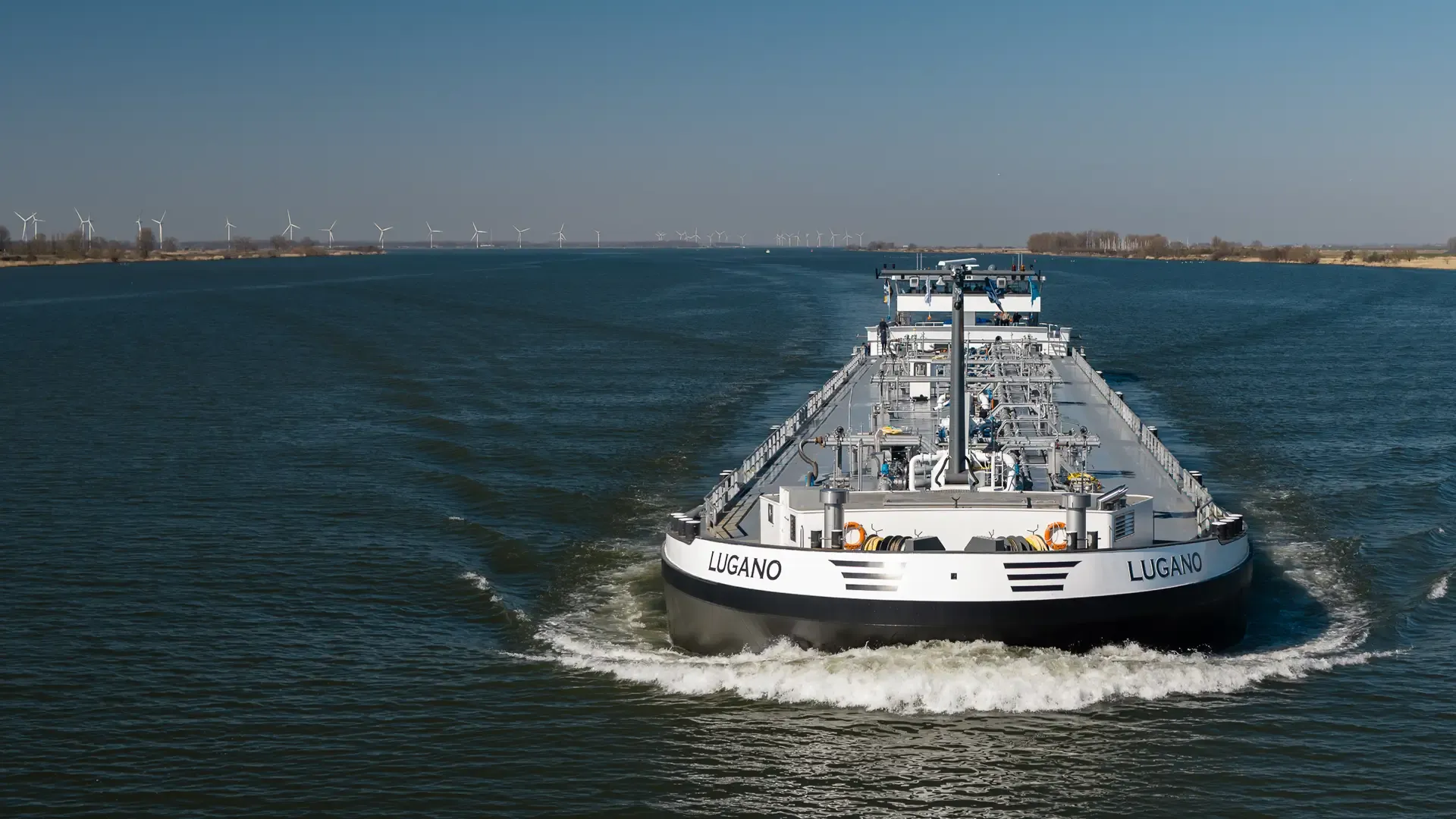
Building a vessel that remains relevant in fifteen years
When Roald Verstraeten from V-Shipping started thinking about a new vessel, he looked beyond today’s requirements. His starting point was simple: if you invest in a tanker that needs to last for decades, it must still be relevant in fifteen years.
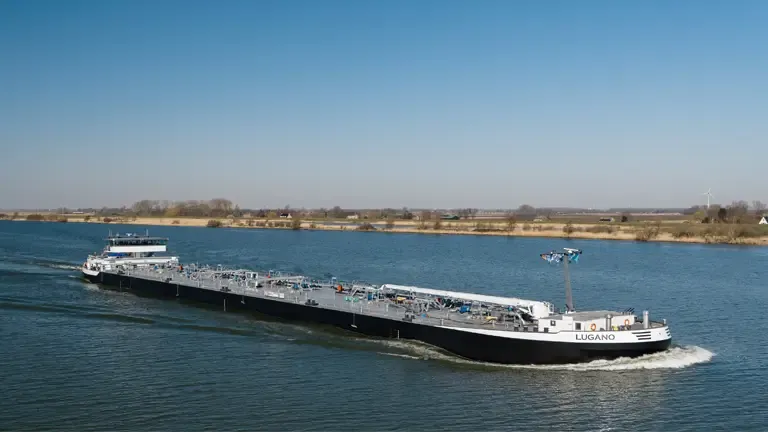
Lugano as a case study
This idea formed the basis for the Lugano. An inland vessel focusing on more efficient operation and lower emissions, as well as on flexibility and reliability. A case that is often cited by Zeppelin Power as well, for example when account manager inland shipping Manouk Leemberg is asked to speak about electrification and hybrid propulsion systems:
“I’d like to use the Lugano as a practical example, and the reason is quite simple. The Lugano clearly demonstrates what is already possible today when you intelligently combine different propulsion technologies,” Leemberg says. “We are proud that we were able to contribute to this forward-looking concept. And who can explain better why these solutions were chosen and how they work in practice than the owner himself?”

"In ten or fifteen years, this vessel should still be up to date. The entire concept is essentially based on that."
Investing ahead without certainty
That Lugano would be different from many comparable tankers was clear from an early stage. Roald Verstraeten saw the market gradually change. Shippers began asking more and more questions about emissions, fuel consumption, and more sustainable forms of transport. At the same time, there was still little certainty. No one could guarantee that clients would actually be willing to pay extra for a vessel that went beyond the usual standard.
"Sometimes you have to make decisions based on your instincts," Verstraeten explains. The basis for that instinct came during a study trip initiated by Zeppelin Power to Chicago, along various Caterpillar factories and locations. There, he saw developments that made him think about the future of inland shipping. Not only regarding alternative fuels, but also about how propulsion can be configured more intelligently and more flexibly. He brought those insights back to the Netherlands and they ultimately became an important part of Lugano's design.
The outcome: a design that keeps multiple directions open. In other words, a flexible vessel.
"The C32 is actually too small for a vessel like this, but because we have added an electric motor behind each propeller shaft as well, we now have a dual system."
Two ways to sail
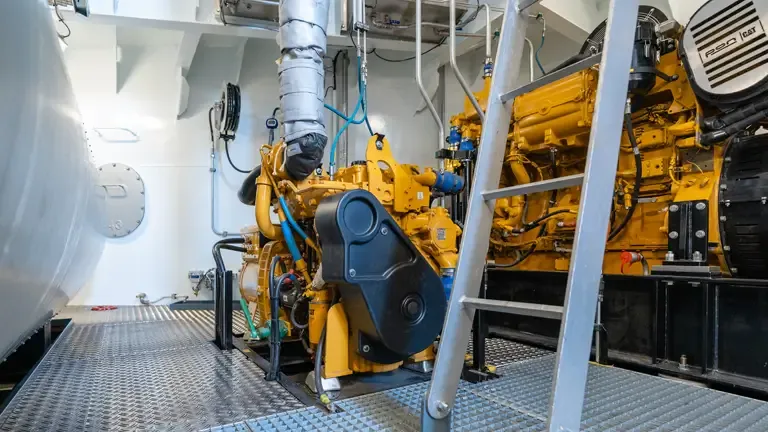
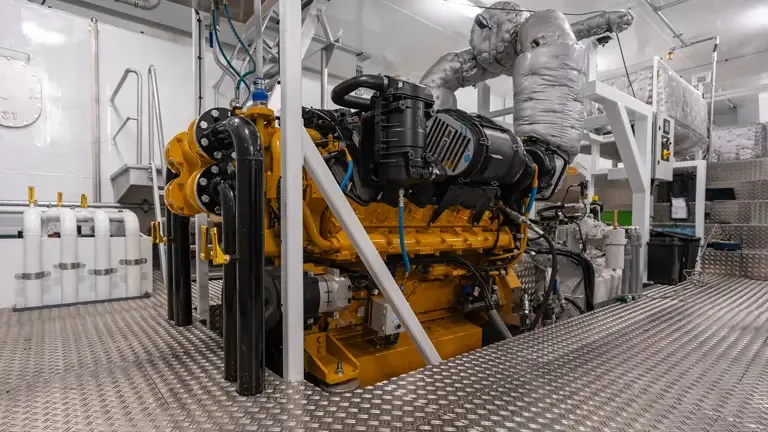
You can see the future-oriented approach in the engine room. The Lugano was fitted with two Cat C32 main engines for propulsion and two Cat C18 generator sets, which play a central role within the hybrid concept. Per propeller, the vessel has both a diesel engine and an electric motor. That means you can choose the propulsion type that best fits the sailing profile at that moment, fully on diesel with the C32 main engines, or electrically via the electric motors, powered by the C18 generator sets.
For Verstraeten, this setup was particularly interesting because it offered greater flexibility. By combining diesel and electric propulsion, it was possible to opt for a different engine configuration than what is typically used on a vessel of this size.
"We installed the C32 and not the 3512," he says. "The C32 is actually too small for a vessel like this, but by placing an electric motor behind each propeller shaft, we have created a dual system."
According to him, this dual system offers multiple advantages. The main engines run fewer hours, so wear and maintenance are kept to a minimum. At the same time, there is always an alternative available when one of the two propulsion systems is not available. Verstraeten: "We can always keep sailing."
Fewer operating hours, less maintenance
The benefits of this approach become clearly visible in day-to-day practice. The Lugano operates mainly in the ARA area, where relatively short distances are covered between ports in Antwerp, Rotterdam and Amsterdam. It is exactly on this kind of route that the hybrid design delivers according to Verstraeten.
Because part of the propulsion is electric, the main engines are less heavily loaded than they would be on a conventional vessel of comparable size. This has a direct impact on wear, maintenance and the total service life of the installation. "By using that dual system, we hardly use the main engines," says Verstraeten. "That makes a big difference in maintenance."
According to him, the benefit goes beyond just fewer operating hours. With the chosen configuration, future overhauls can also be managed more effectively. The main engines are subjected to less load, while a significant part of the daily work is handled by the generator sets.
“The C18s are really the stars of the show,” says Verstraeten. “We also use them for unloading. But when one of those C18s eventually needs an overhaul, you’re looking at a completely different investment compared with a conventional main engine for a vessel of this size.”
For an entrepreneur who looks at the long term, this matters. Not only the investment you make today, but also the maintenance costs of tomorrow ultimately determine how future-proof a vessel really is.
A solution that fits the operating area
At the same time, Verstraeten remains realistic about the possibilities of electrification. The benefits that the Lugano demonstrates in the ARA region are, according to him, not automatically applicable everywhere. On the Rhine, for example, where vessels travel upstream for extended periods, the power demand is significantly higher. Verstraeten: "If you sail towards Mannheim, you are constantly going against the current. Then you simply need power."
That is precisely why he is not convinced by the idea that one technology provides all the answers. For some applications, electrification works extremely well, for other situations a conventional drive system remains, for now, the most logical choice. According to Verstraeten, the energy transition is therefore not about choosing a single winner, but about smartly combining different technologies.
That is exactly what he tried to do with the Lugano. Not building for just one scenario, but for different scenarios. Not opting for today's solution, but for a vessel that can adapt to what tomorrow demands.
Prepared for the next step
That thought also played a role in the choice of the main engines. During the study trip to Chicago, Verstraeten learned more about the possibilities of methanol as a fuel. For him, that was one of the reasons to consciously choose the Cat C32. Verstraeten: "If we are ever allowed to operate on methanol, that engine is relatively straightforward to convert."
With that, he does not mean that methanol will become the standard tomorrow. Too many factors are still uncertain for that, from regulation to availability and price developments. What he did want to prevent is the ship later getting stuck with choices that were made today.
According to Verstraeten, the Lugano is therefore already prepared for a possible next step. If methanol becomes economically interesting and if regulations allow it, the ship does not need to be completely redesigned.
Verstraeten: “We’ve built a future-proof vessel, ready for transitions that we can’t fully anticipate yet.”

Meer lezen over onze oplossingen?

Alcohol as fuel
In this article, we outline alcohol fuels that can be used in engines, along with their pros and cons.

Cat engine De Hein exceeds the 100,000 operating hours limit
Van der Kamp has been a Zeppelin Power customer since 2000. In 2005, we installed Caterpillar engines on De Hein. In 2022, the 3406…

The major differences between FAME and HVO
There are significant differences between FAME and HVO, the two main biofuels, and how they can be used in engines.

Is methanol the alternative to diesel oil in shipping?
In 2018, 173 IMO countries agreed to cut CO2 emissions from shipping 50% by 2050, focusing on alternative fuels like methanol.

Mega maintenance project under great time pressure
Zeppelin Power completed major maintenance under high pressure on Wagenborg Offshore’s Walk to Work vessel Koeningsborg.

Permanent magnet generator
How can you charge your yacht's batteries efficiently and environmentally friendly without having to go to shore?

ULEV notation
Strict environmental standards such as Tier and Stage V apply in shipping. Zeppelin Power goes even further with the ULEV notation.

Sailing on methanol
Technology for sailing on methanol is under development, and ships need to be adapted. Read more about it in this article.

Solar panels help Porsche Amsterdam
Over 238 solar panels make the workshop self-sufficient—green, sustainable, economically attractive, and necessary due to grid…

Greater capabilities thanks to Zeppelin Group
Discover how the power of Zeppelin Group brings more knowledge, innovation, and better service to our customers.